How to Pick the Right GEO for Your Promotion
As an affiliate marketer today, virtually any country can serve as your market, and virtually anyone on the planet can become your next buyer or lead.
You have likely come across the TIER country breakdown. This term is widely used across the online marketing industry. There is no definitive country-by-country split and no precise rule that defines it. The split is closely tied to payouts, traffic costs, geo market regulations and the audience's standard of living.
On this basis, there are 3 major TIER groups:
Tier 1 countries - these are regarded as the most competitive, with the most expensive traffic.
Tier 2 countries - these GEOs are less competitive and their populations have lower average incomes.
Tier 3 countries - these GEOs offer very little potential in terms of buying power.
Tier 1 covers English-speaking countries and some European countries, Tier 2 is generally most of Europe, and Tier 3 is the rest of the world.
Every country has its own regulations, and online audiences are no exception. Tier 1 countries are the most heavily regulated, since they have been worked for years and governments have introduced rules to protect their citizens. From an affiliate standpoint, these regulations (especially around carrier billing) directly affect advertising campaigns and conversion rates. So even though payouts in these countries can be very high, sometimes the extra hassle and struggle isn't worth it.
On the other hand, developing countries that fall into Tier 2 and 3 have fewer regulations, much cheaper traffic, and more opportunities for you as an affiliate marketer to run a stable campaign with better conversion potential.
ZETA countries
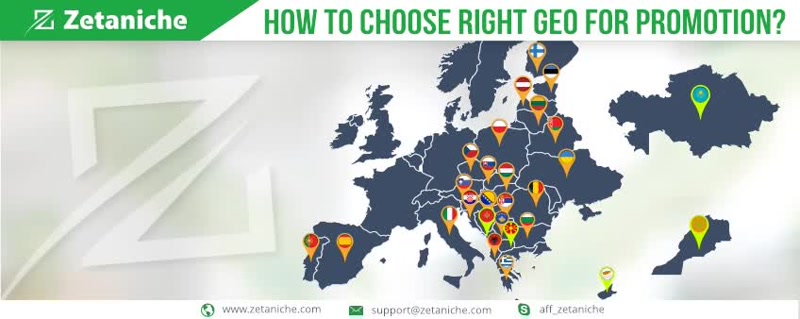
Zetaniche is covering: Albania, Belarus, Bosnia and Herzegovina, Bulgaria, Croatia, Cyprus, Czech Republic, Estonia, Finland, Greece, Hungary, Italy, Kazakhstan, Latvia, Lithuania, Macedonia, Montenegro, Morocco, Poland, Portugal, Romania, Serbia, Slovakia, Slovenia and Ukraine.
Zeta countries are mostly regarded as Tier 2. Beyond the lower competition, cheaper traffic, lighter regulations and easier mobile traffic monetization we've already covered, this post focuses on something very important: audience habits and buying interest in these GEOs.
Since we can't cover every country one by one, we'll share a few general pointers to help you see why these GEOs may be an excellent choice for you.
Europeans are quite active in the online market. One in four Europeans with internet access shopped online at least once a week last year, while over 60% shopped online once a month. 6% of Europeans shop online every day.
Central Europe
Poland is one of Europe's largest countries by population and is currently seeing enormous growth in online buying. About 75% of the population has already tried online shopping at some point, and 46% shop online regularly. One in four internet users in Poland already shops online and plans to increase their online spending. That makes Poland a European country you shouldn't miss!
In the Czech Republic market, most 25-54 year-olds spend between €100 and €500 on online purchases. Cash on delivery is the preferred payment method in the Czech Republic, as well as in Hungary (you can read more Hungary marketing insights in this post).
In Slovakia, average spending per buyer was €202 last year and 90% of online orders were placed via desktop, while in Slovenia average spending per buyer was €359. Cash on delivery is the most common payment method in Slovenia, with 46% preferring it.
Southern Europe
Italy is Europe's third-largest economy and a founding member of the European Union. Studies show that people aged 35 to 44 form the largest group of Italian online buyers and use smartphones most for this activity. On delivery preferences, 92% of online buyers in Italy prefer to receive deliveries at their offices and homes. As for payment, Italians favor PayPal or similar methods, followed by debit/credit cards and cash on delivery.
In Portugal, over 46% of 16-54 year-olds purchased online in the last 12 months, and they spent 4.2 billion euros online last year.
Greece's buying power is less advanced than in other EU member states, largely due to the prolonged economic crisis. Cash on delivery remains the most popular payment method. Web-based trade in Cyprus remains relatively small but is growing.
North Europe
3.2 billion euros was spent on online purchases in Finland last year. Mobile devices are used for research and price comparison, but three out of four online purchases in Finland are still made on a computer.
There are currently 1.32 million internet buyers in Lithuania. Males aged 25-34 hold the biggest market share, at 230,000 buyers. The second-largest group of online buyers is women aged 25-34.
In Latvia, 78 percent of the total population uses the internet every day. According to recent official data, 44% of the Latvian population made online purchases in the past year.
In Estonia, consumers made an average of 8.4 online purchases in 2016.
Eastern Europe and Balkan countries
4 million Bulgarians purchased online in 2016. Most online buyers in Bulgaria prefer to pay with cash on delivery. 89% of online shoppers in Bulgaria shop via desktop, 5% made purchases via smartphone, and just 3% made their most recent purchase via tablet.
According to data reports, the vast majority of online consumers in Romania (90%) prefer to pay cash on delivery. The average online buyer in Romania is between 25 and 35 years old.
Online ordering is becoming increasingly popular in Ukraine. Ukraine's population is 45.2 million people, of whom 58% use the internet. 3.7 million of these internet users buy online.
In Belarus, most people prefer to pay by cash on delivery, chosen by 60% of online users. Credit card payments are far less popular, used by 13% of Belarusian online consumers. Next comes paying via cell phone, which just 0.3% have ever used.
Of those with internet access in Macedonia, 19.3% ordered online in 2016. Facebook advertising is currently the most successful, thanks to Facebook's popularity in Macedonia.
In Croatia, 47% of online buyers prefer paying with cash on delivery, and 65% of online purchases in Croatia are €50 or less.
61% of Montenegrins are frequent internet users. Thanks to rising consumer awareness and product demand, Montenegro should be on your promotion list too.
Nearly 60% of Serbians are frequent internet users. The number of online orders in Serbia exceeded 2 million in 2016.
Ordering online with a credit card in Bosnia and Herzegovina is not that common. Cash on delivery is the most popular method.
In Albania, internet shopping is still in its early stages, due to low credit card use, low purchasing power and high shipping costs. Facebook is widely used for marketing.
Central Asia and North Africa
Internet use in Kazakhstan grew quickly over the last year, reaching 77% of the population in 2016. The most advanced purchase types are online payments for mobile services and public utilities. Payments for online orders from Kazakhstan are mostly made by cash on delivery or bank transfer, and rarely by credit/debit cards.
In Morocco, internet usage recorded 8% growth in 2016. Morocco has one of Africa's highest internet breakthroughs, and online buying in this geo is being built on that.
We hope this information has shown you that buying power in ZETA countries exists, some of these countries are still developing, but for you as an affiliate marketer that means more room for testing and exploring, especially once you have a clearer picture of audience habits and needs. We should also note that in 70-80% of Zeta countries cash on delivery is the preferred delivery model for all online purchases, which is one more reason to start promoting our COD offers!
Feel free to contact us at [email protected] or reach us on Skype at aff_zetaniche for more information on any of these countries. We'd be glad to help with our experience and knowledge!
One more important note! Make sure you find out about the top GEOs and offers in time. Subscribe to our newsletter and get weekly updates on our top GEOs and offers!